

In cycling, comfort comes from a precise balance between body, movement and materials.
Every detail directly affects riding comfort, posture and the ability to maintain performance over time.
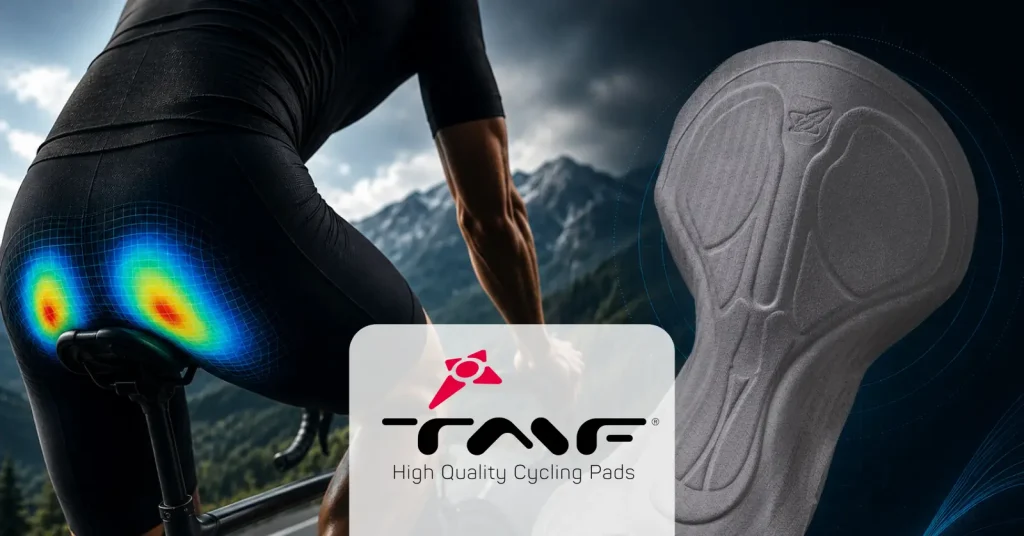
Biomechanics studies these dynamics. It analyzes how the body interacts with the saddle, how pressure is distributed and how movement affects the perceptions.
For TMF, biomechanics represents a core element for a cycling pad development.
Every development phase, from material selection to geometry definition, is studied to ensure comfort, support and consistent performance during the ride.
Comfort Starts from Design
When a cyclist sits on the saddle, body weight concentrates on specific areas. The ischial bones, the perineal area and the contact points with the saddle become critical zones, especially during long-distance rides.
When these pressures are not properly managed, the outcome is well known:
This is where biomechanics plays a key role. It allows these dynamics to be interpreted and translated into design solutions.
A high-performance chamois is not designed to eliminate pressure, but to distribute it efficiently over time.
The body in motion changes the needs.
One of the most complex aspects is that pedaling is never static. The pelvis moves, posture shifts and intensity varies.
A chamois must adapt to a constantly changing system.
For example, in road cycling, the position is more stable and aerodynamic. While in gravel and MTB, variations are more frequent and pronounced. This means that pressure areas continuously change.
To respond to this variability, TMF develops solutions designed to follow the body’s movement without creating stiffness or pressure points.
Technologies such as T-Novib are performing to absorb and reduce vibrations before they are transfered to the rider’s body, while geometries and elastic constructions allow the chamois to follow the cyclist’s movement throughout every phase of pedalling.
Materials and Comfort: A Dynamic Approach
Biomechanics also guides materials’ selection. It is not about choosing the most high-performing material overall, but the one best suited to the body’s behavior during activity.
Multi-density foams, for example, make it possible to manage load zones in different ways. Areas subject to higher pressure receive greater support, while others remain softer and more adaptive.
Alongside this, technologies such as Airmesh come into play. This is not a foam but a three-dimensional component. It provides cushioning while limiting moisture retention, improving the feeling of dryness even during long rides.
Moisture management is also part of biomechanics. When the skin stays dry, comfort improves and the risk of irritation decreases. Solutions such as the QuickDryFrame®, designed to promote moisture channelling and faster drying, help maintain a stable and long-lasting feeling of comfort over time.
Vibrations and Micro-Trauma: The Invisible Challenge
Every terrain transmits vibrations. Even when they are not clearly perceived, these stresses have an impact over time.
In the long term, vibrations generate micro-traumas that increase fatigue and reduce ride quality. This is where biomechanics makes a difference.
A chamois developed with this focus can:
- reduce vibrations
- protect sensitive areas
- maintain a smoother pedaling experience
Every cyclist is different
There is no single way to ride. Weight, posture, experience and discipline vary.
A professional cyclist maintains a more extreme and aerodynamic riding position, while an amateur tends toward a more relaxed posture. These differences directly influence pressure distribution and the behavior of the chamois.
At TMF’s R&D Center, this variability is studied through testing on different body morphologies and riding conditions. The goal is to develop chamois that are not simply standardized, but adaptive.
The TMF method
TMF integrates biomechanics into every stage of development:
- pressure analysis
- movement study
- on the road and lab testing
- high-tech material selection and combination
The result is cycling chamois designed to perform in real riding conditions, not in ideal situations.