

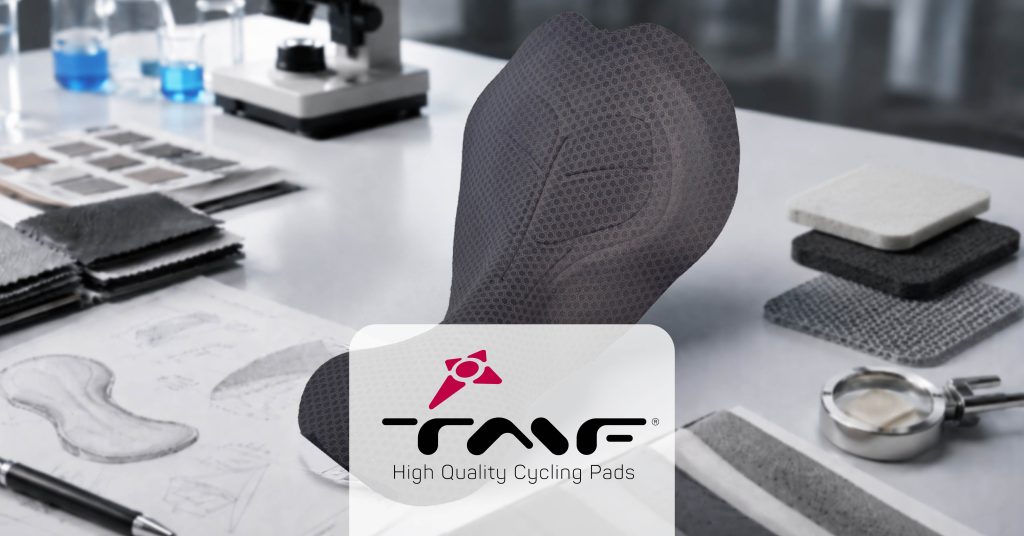
A Guide to Understand How a High-Performance Cycling Pad Is Developed
Anyone involved in developing technical cycling apparel knows that comfort depends on much more than a single component. Fabrics, garment construction, fit and finishing details all contribute to the rider’s overall experience.
Among these elements, the cycling pad plays a central role.
It is the component positioned between the rider and the saddle, supporting every pedal stroke throughout the ride. Its performance directly affects pressure distribution, vibration management and long-lasting comfort under different riding conditions.
For this reason, the pad is one of the most technical components of any cycling short.
Its development combines expertise from several disciplines. Biomechanics, ergonomics, material research, industrial design and on-road testing all contribute to creating a product capable of meeting the specific demands of each cycling discipline.
There is no single cycling pad suitable for every application.
The requirements of a rider tackling a long-distance road event differ significantly from those of someone riding gravel, mountain bike, enduro or triathlon. Riding position, duration, terrain, vibration levels and performance expectations all change according to the discipline.
Pad development is also continuously evolving. New materials, dedicated technologies, increasing attention to sustainability and ongoing ergonomic research are constantly redefining the way next-generation cycling pads are designed.
Why the Pad Is the core of Cycling Shorts
During every ride, the pad follows the rider’s pelvic movement, helps distribute pressure, manages moisture and contributes to reducing fatigue caused by continuous vibrations and impacts.
For this reason, a cycling pad should never be considered just another garment component, but rather a genuine engineering project.
Every design decision begins with a fundamental question: who is the product intended for?
A collection developed for road cycling requires different characteristics from one designed for gravel, mountain biking or triathlon. Riding position, ride duration, terrain and vibration levels all vary according to the discipline. As a result, the performance requirements of the cycling pad also change.
For technical apparel developers, this means considering the pad as an integral part of the garment from the very first stages of product development. The decisions made at this stage directly influence rider comfort, long-term performance and the overall market positioning of the collection.
Every cycling pad is therefore the result of a careful balance between ergonomics, materials, research and its intended application.
Further Reading
If you would like to explore these topics in greater depth, we recommend the following articles:
- How to Choose the Right Cycling Pad for Every Discipline – An overview of the specific requirements of the main cycling disciplines and how pad design changes according to the intended use.
- A Promise of Quality: The Journey of a TMF Pad from Design to the Road – Discover how a TMF cycling pad evolves from its initial concept through development and real-world validation.
- The Art of Custom Cycling Pads – Learn how a bespoke cycling pad is developed to meet the specific needs of a brand and its collection.
How Biomechanics Drives Pad Development
An effective cycling pad begins with a deep understanding of human movement.
During pedalling, the pelvis is never static. Every change in pace, gradient or riding position alters the rider’s contact points with the saddle, affecting pressure distribution.
Each cycling discipline also influences these dynamics. A road cyclist maintains a different riding position from a mountain biker tackling technical trails or a gravel rider constantly changing posture.
Biomechanics allows these movements to be observed, analysed and transformed into valuable design data.
The objective is to understand how the body interacts with the pad throughout the entire ride.
This information guides decisions regarding shape, thickness, foam distribution and material selection based on the rider’s actual behaviour rather than theoretical assumptions.
For Product Designers, this means developing products based on measurable data instead of relying solely on experience or subjective perception.
For Product Managers, it means creating collections that are more closely aligned with both the target customer and the intended discipline.
Biomechanics also serves as an essential validation tool.
Every design solution is tested to verify whether the expected behaviour matches real riding performance. This iterative process allows continuous refinement, highlighting opportunities for improvement that would hardly emerge through visual evaluation alone.
The evolution of modern cycling pads is closely linked to this development approach.
The study of human movement has driven the creation of new geometries, higher-performing materials and innovative technologies for managing pressure distribution, vibration absorption and long-distance comfort.
For this reason, biomechanics is not a separate stage of development but a fundamental element supporting every phase of the design process—from the initial concept through to final product testing.
Further Reading
If you would like to explore the role of biomechanics and research in cycling pad development in greater depth, we recommend the following articles:
- Applied Biomechanics: The TMF Approach to Optimising Rider Comfort – Discover how body movement, pressure distribution and pad design work together to enhance comfort and performance.
- TMF Research & Development: Engineering Cycling Pads for Maximum Performance – Learn how research, experimentation and testing drive the continuous evolution of TMF cycling pads.
- Inside the TMF Research & Development Centre: Where Our Cycling Pads Take Shape – A behind-the-scenes look at the laboratory where new design concepts are developed, tested and validated.
- The TMF Innovations That Have Shaped Modern Cycling – Explore the key innovations that have helped improve rider comfort and performance over the years.
Why Materials and Technologies Make the Difference
The performance of a cycling pad is the result of the interaction between materials, construction and technologies, all carefully developed to meet specific riding requirements.
Foam selection, for example, plays a key role in determining support and the pad’s ability to maintain consistent performance over time. Likewise, fabrics contribute to moisture management, breathability and next-to-skin comfort.
Material placement is equally important. Different geometries, thicknesses and density zones are strategically engineered to distribute pressure evenly while allowing the rider to move naturally without restriction.
Moisture management, for instance, relies on solutions that promote rapid sweat dispersion throughout the ride. Ventilation depends on materials and constructions designed to enhance airflow inside the pad. At the same time, vibration management is achieved through the development of materials and structures capable of improving comfort over long distances and on rough terrain.
In recent years, sustainability has also become an integral part of TMF’s development process. The introduction of bio-based materials and recycled components demonstrates that innovation and environmental responsibility can successfully coexist without compromising the performance demanded by modern cyclists.
At TMF, understanding the role of every material is essential to designing products that truly meet riders’ expectations. Technologies are not valuable on their own—they deliver real benefits only when they are integrated into a product specifically engineered for its intended application.
Further Reading
If you would like to learn more about the materials and technologies behind TMF cycling pads, we recommend the following articles:
- QUICKDRY FRAME® – Discover how enhanced moisture management contributes to greater riding comfort.
- How Airmesh® Improves Breathability in TMF Cycling Pads – The importance of ventilation in high-performance pad design.
- How T-Novib® Protects Riders Through Advanced Anti-Vibration Technology – An in-depth look at TMF’s vibration-management solutions.
- Bio-Based Foam Cycling Pads: Where Comfort Meets Sustainability – How environmentally responsible materials are shaping the future of cycling pads.
- PRIUS Pad: Sustainable Comfort for Long-Distance Riding – A practical example of how materials, construction and research come together in a single product.
- The Innovation Behind Every TMF Cycling Pad – Discover the research process that drives the development of new technologies and materials.
Every Cycling Discipline Requires a Dedicated Design
There is no universal cycling pad.
Each cycling discipline presents unique demands that influence riding position, ride duration, terrain and the stresses experienced by the rider. As a result, every pad must be specifically engineered for its intended application.
For road cycling, long-distance comfort is the primary objective. Riders maintain a relatively stable position, requiring a pad that provides consistent support while remaining lightweight and highly breathable.
Gravel riding presents different challenges. Uneven terrain, frequent posture changes and constant vibrations require a design that combines stability, freedom of movement and effective vibration management.
In mountain biking, the rider continuously shifts body position while alternating between pedalling and technical sections. Enduro and downhill introduce even greater body movement and higher-impact forces, demanding dedicated solutions focused on protection and support.
Triathlon is another unique discipline. The pad must deliver comfort during the cycling leg without compromising freedom of movement while running, while also drying quickly after the swim.
Finally, the growing popularity of e-bikes has introduced new design requirements. Longer rides and extended time in the saddle have increased the need for pads that provide lasting comfort, excellent breathability and continuous support.
Climate also plays an important role in pad development. Summer riding requires particular attention to moisture management, ventilation and fast-drying performance—all essential factors in maintaining rider comfort during hot-weather conditions.
For this reason, every TMF cycling pad begins with one fundamental question:
Where, how and by whom will it be used?
The answer guides every stage of development, from internal construction and material selection to the integration of the technologies best suited to that specific application.
| Discipline | Riding Characteristics | Pad Design Focus |
| Road | Stable riding position and continuous pedalling | Pressure distribution, lightweight construction and long-distance comfort |
| Gravel | Mixed terrain, frequent vibrations and posture changes | Stability, freedom of movement and vibration management |
| MTB | Dynamic riding with constant body movement | Ergonomics, flexibility and technical riding comfort |
| Enduro | Demanding terrain with heavy impacts | Protection, durability and support during aggressive riding |
| Downhill | Technical descents and high-impact riding | Freedom of movement and protection in high-pressure areas |
| Triathlon | Swim-bike-run transitions | Lightweight construction, fast drying and minimal bulk |
| E-bike | Longer rides and extended time in the saddle | Long-lasting comfort, breathability and consistent support |
Further Reading
To explore the specific requirements of each cycling discipline, we recommend the following articles:
- How to Choose the Right Cycling Pad for Every Discipline – A complete guide to selecting the most suitable pad according to the intended application.
- Maximum Performance on the Trails: A Practical Guide for MTB Riders – Understanding the specific design requirements of mountain bike pads.
- Gravel Riding: Why the Right Pad Makes All the Difference – Comfort, stability and freedom of movement for one of cycling’s fastest-growing disciplines.
- Comfort for Enduro Riders – Designing cycling pads capable of meeting the demands of technical terrain.
- TMF Downhill Pads: The Ideal Support for Extreme Descents – The role of the cycling pad in downhill performance.
- Choosing the Right Pad for Triathlon – The essential features required for a discipline combining swimming, cycling and running.
- E-Bike Comfort: Why TMF Pads Make the Difference – How rider expectations evolve with electrically assisted cycling.
- Summer Riding: Choosing the Right Pad for Hot Weather – The importance of breathability, moisture management and fast-drying materials.
Designing for Women’s Cycling
Women’s cycling has experienced remarkable growth in recent years, accompanied by an increasing focus on the specific needs of female athletes and recreational riders alike.
This evolution has also transformed the way technical cycling apparel is designed.
Developing a cycling pad for women is not simply a matter of adapting an existing model. It requires dedicated research into female anatomy, riding posture and biomechanics—factors that directly influence comfort throughout the ride.
The objective is to provide effective support that follows the body’s natural movements while ensuring comfort across a wide range of riding conditions.
Beyond these core design principles, new challenges have emerged that require equally dedicated solutions. One of the most significant concerns rider comfort during menstruation, a topic that has long been overlooked in the development of technical cycling apparel.
At TMF, innovation also means listening carefully to female cyclists and transforming their real needs into products that genuinely enhance the riding experience.
This philosophy led to the development of NUVIA – Just on Period, TMF’s cycling pad specifically engineered to provide additional comfort and support during menstruation.
Thanks to dedicated engineering and carefully selected materials, NUVIA demonstrates how innovation can make cycling more inclusive without compromising comfort, hygiene or performance.
Designing for women’s cycling therefore means expanding the scope of research, creating solutions that respond not only to the demands of each discipline but also to the people who experience it every day.
Further Reading
If you would like to learn more about the development of cycling pads specifically designed for women, we recommend the following articles:
- Women’s Cycling: How TMF Pads Make the Difference – Discover how cycling pad design has evolved to meet the needs of today’s female riders.
- Women Who Inspire Cycling: TMF’s Commitment to Women’s Performance – A journey through the athletes who have helped shape women’s cycling and TMF’s ongoing commitment to the sport.
- NUVIA – Just on Period – Learn more about TMF’s innovative cycling pad developed to provide comfort and protection during menstruation.
From the Laboratory to the Finished Product
Every TMF cycling pad begins its journey long before production starts.
Behind every product lies a structured development process involving research, collaboration with brands, engineering, prototyping, testing and continuous refinement. Every stage contributes to transforming a product requirement into a reliable solution capable of delivering lasting comfort and performance.
Before selecting materials or technologies, it is essential to understand which cycling discipline the pad is being developed for, the riding experience it is expected to deliver, and the features that will distinguish it within the collection.
These principles form the foundation of the entire development process.
The first concepts are translated into prototypes, allowing engineers to evaluate the behaviour and performance of different materials. Testing is a crucial stage: every design iteration is assessed to understand its impact on pressure distribution, freedom of movement, breathability, and the pad’s ability to deliver consistent performance over time.
At TMF, Research & Development is not a separate function but an integral part of the design process. This continuous cycle of research, prototyping and testing drives the development of new solutions, innovative materials and advanced technologies that evolve alongside the demands of modern cycling and the needs of leading brands.
Another cornerstone of TMF’s approach is customisation.
Every brand develops collections with a distinct identity, targeting different riders and riding applications. For this reason, TMF cycling pads can be engineered and tailored to become a fully integrated component of each customer’s product, helping strengthen both brand identity and market positioning.
Innovation is the result of this ongoing dialogue between research, technical expertise and a deep understanding of market needs.
Designing a Cycling Pad Means Designing the Rider’s Experience
Every cycling pad contains far more engineering than meets the eye.
Biomechanics, research, materials, technologies and product development all work together to transform an invisible component into one of the key factors influencing comfort and performance on the bike.
For this reason, developing a cycling pad requires specialised expertise, continuous innovation and a deep understanding of the needs of different riders and cycling disciplines.
In this guide, we have explored the fundamental principles that drive the development of increasingly advanced cycling pads.
Developing a New Cycling Collection?
Every project comes with its own unique requirements.
Whether you are creating a road, gravel, mountain bike or women’s cycling collection, selecting the right pad is one of the most important decisions in defining both rider comfort and the perceived value of the finished garment.
If you would like to discuss the most suitable cycling pad for your next collection, the TMF team is here to help.
We’ll be pleased to put our expertise at the service of your project.
→ Contact TMF and tell us about your next project.